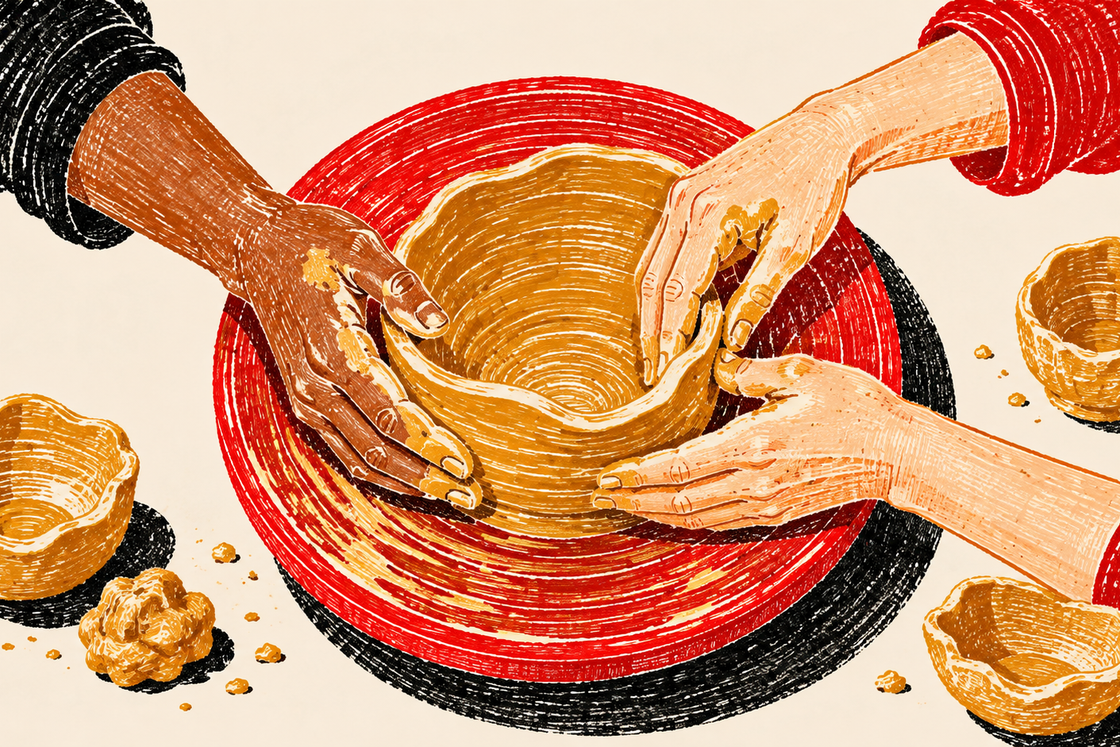
But let there be spaces in your togetherness, And let the winds of the heavens dance between you.
— Kahlil Gibran, “On Marriage,” The Prophet (1923)
We met over a pottery wheel neither of us knew how to use. For two hours, a stranger and I pressed our thumbs into wet clay, ruined three bowls between us, and laughed at the fourth. I learned almost nothing about her: not her work, not her city, not her story. And yet I left feeling I knew her better than people whose grief I have watched unfold, in real time, on my phone.
The Onion
Social Penetration Theory pointed out that two people getting to know each other through various stage, one after another, similarly to the process of peeling an onion.
In Altman & Taylor's model, reciprocity is the central thread that keep the process happen where the two stakeholder take turn do their parts in growing the connection by peeling their own sleeve.
What is often forgotten is that the peeling happens in turns. I show you a little; you show me a little back. In their model, closeness depends on reciprocity as much as on depth.
We, living in a fast pace world of digital, have many reasons to confidently not follow that, since we have a great deal to actually see the very intimate layer of someone due to their active choice of open-up through social media. But the point is, that is not their actually intimate layer, it is their choice to show the public something about them, either true or not, to achieve a certain goal, mostly in communication and personal branding.
The One-way street
That leads to a very weird situation for others to think that they know someone through their active digital activities. That seems to be wrong, because that engagement and knowledge is a one-way street, parasocial relationships, a term coined by Horton & Wohl in1956). You scroll and thought you know a person deeply because they just shared their deepest pain like Selena Gomez most recently in a livestream cried about people suffering from painful incident but accidentally got mistaken for another private matter of her and her husband Franco. But that is purely their side, how about yours, was that engagement mutual, did they in return got to know some thing equally intimate about you? Not at all.
The space in between
In Japanese, there are many beautiful word that describe a very abstact state of human connection philosophy which I personally very much in love. We have heard alot about Ikigai, but to day, I want to introduce a very term that help us understand a very sophisticated stage of people in a relational connection with others: 間 (ma) and 人間 (ningen)
01間 (ma)
means the interval, the meaningful space between things.
02人間 (ningen)
The Japanese word for human being, literally contains "between." The philosopher Watsuji Tetsurō built a whole ethics on this. He called it aidagara (betweenness) and argued that we exist as persons only in relation.
In Vietnamese, we have Nhân Gian meaning the world that exists between people
In Martin Buber’s words I and Thou with the idea that relation comes first, before any “I”
The psychoanalyst D. W. Winnicott describe the "potential space" where play first happens, and where, he believed, art and culture would later live.
This is what I mean by the third space. It is not the café or barbershop that the sociologist Ray Oldenburg called the "third place," somewhere that is neither home nor work. It is not a place at all. It belongs to neither of us, is made only by both of us, and exists only while we keep making it.
At the pottery wheel, the third space was the clay. We knew each other through the ruined bowls, not through confession. This may explain something many of us have felt: why some relationships become intimate quickly and fall apart just as fast. They skip the between. They have disclosure without anything built in common.
Beyond two people
And it isn't only between people but people andtheir objects, project, experience; you and your own life, you and yourself
There is that space between anyone, any two thing, any two or group of people getting evolve with one another.
You, actively or by accident, create that space between you and your life, if it is filled with others opinition, or fears, … then that space would not grow healthily.
What grows in the space in between (The praise part to write)
- It cannot be downloaded, only built, and only slowly.
- It asks both sides to bring something, which is what makes it trustworthy.
- It may outlast the relationship itself: something of it stays in each person.
- It is where craft, and much of what Woven cares about, actually lives.
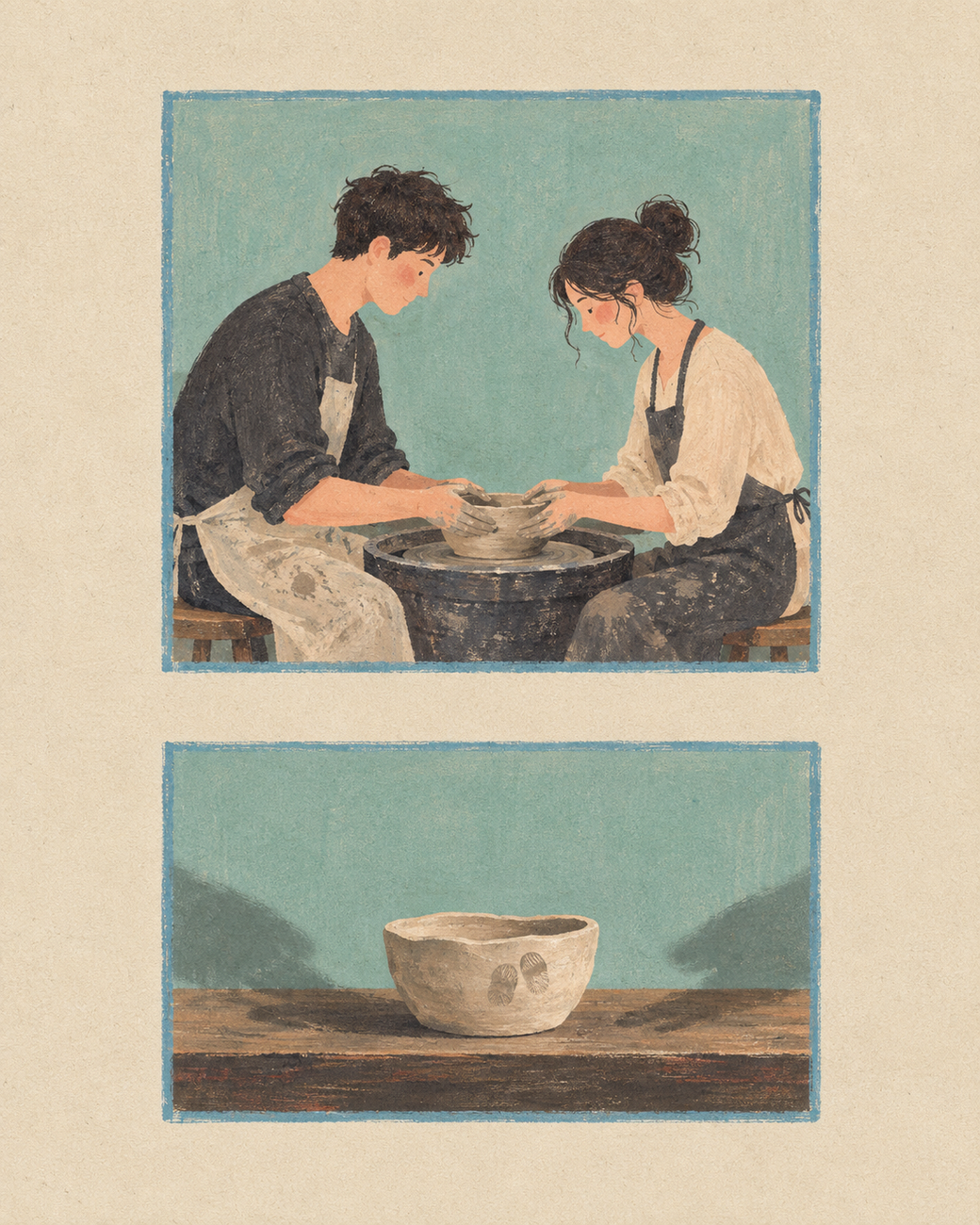
I don't know if I'll see her again. The fourth bowl sits on my shelf, lopsided, thicker on one side where her thumb pressed and mine didn't. Kahlil Gibran once asked lovers to let there be spaces in their togetherness. For years I read that as advice about distance. I read it differently now. The space was never the gap between us. It was the bowl.